



_ urban data mining
tag: [work] [phygital] [digi]
classification: 2024 Digerati Emergent Media Festival
location: Daniels & Fisher Clocktower Denver Colorado US
team: Jack Wasielewski & Tyler Lehmann
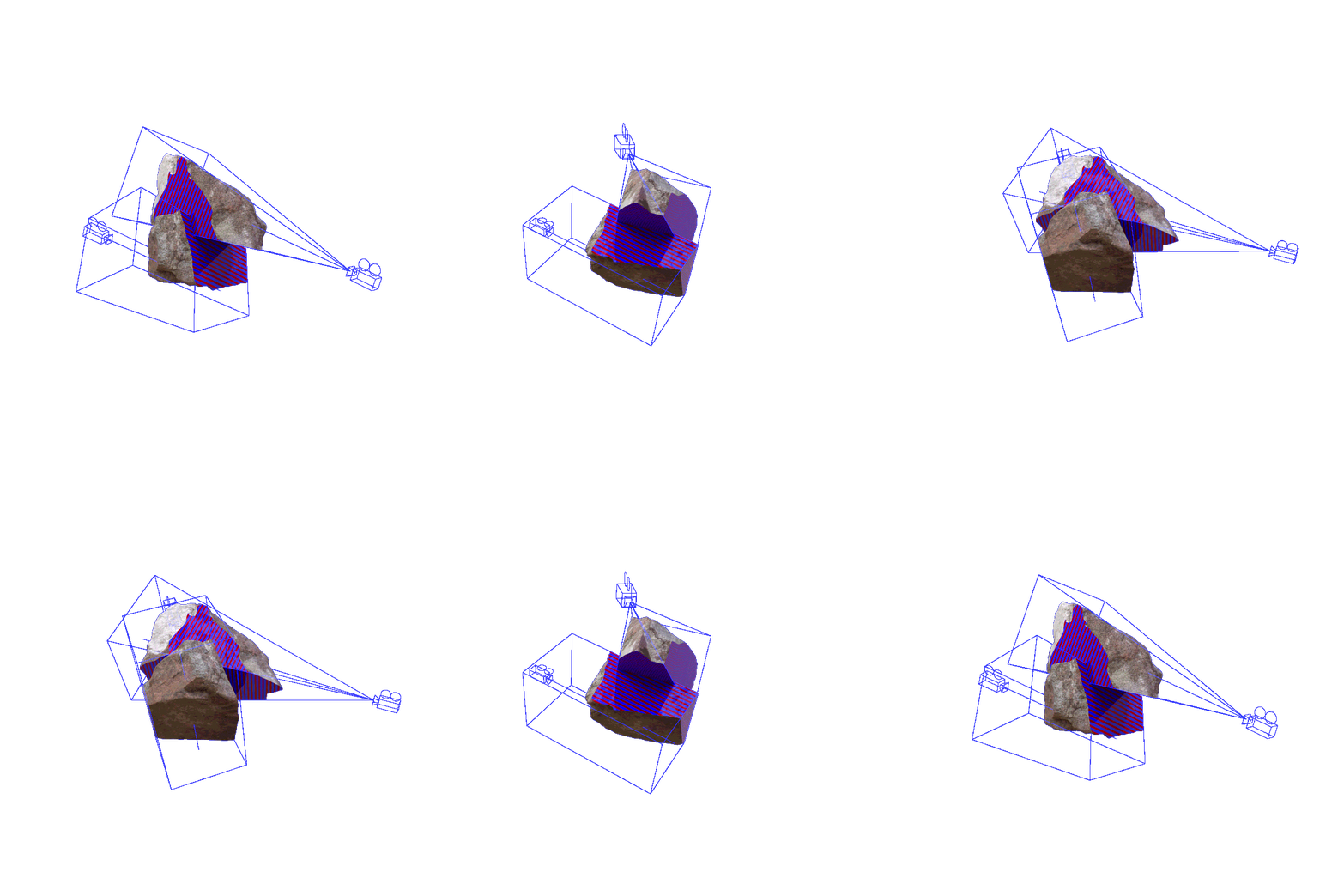
Urban Data Mining is a projection-mapping public digital art project developed for the historic Daniels & Fisher Tower, a 325-foot-tall landmark built in downtown Denver in 1911. The project digitally reconstructs the tower piece by piece as a dataset of 76,484 individual components, documenting each element through attributes including geometry, dimensions, material, color, location, and architectural characteristics. These components are subsequently visualized as metadata tags mapped directly onto the building through projection and machine-vision techniques.
Rather than treating the existing building as a singular architectural object, the project approaches it as an enormous collection of discrete materials and information. The tower is computationally disassembled into a digital kit of parts in which every component can be identified, described, classified, retrieved, and recombined. Deconstruction therefore becomes not simply the destruction of architecture, but an act of design: a process through which an existing building can be converted into a searchable material and informational resource.
This process forms part of a broader investigation into AI metadata documenting and curating. Conventional architectural documentation attempts to stabilize information through drawings, models, schedules, and specifications. Urban Data Mining instead asks what happens when architectural documentation becomes a dataset capable of actively participating in subsequent design operations. Each component is no longer represented only by its geometry; it is accompanied by descriptive information that determines how computational systems recognize, categorize, and eventually reconstruct it.

The project tests this relationship by allowing the pre-collected dataset to feed a simulated reconstruction of the tower. Because the components have already been catalogued, seemingly minor changes can be introduced at the level of metadata while the larger database remains intact. A small modification to the description of a material, stylistic attribute, or architectural characteristic can cause the corresponding component to emerge from the database in a substantially different form.
The consequence can be disproportionate. A tiny alteration in data can produce a dramatic transformation in architectural appearance. A component whose geometry and position originate from the same architectural database may suddenly acquire a different material identity, stylistic association, or formal expression simply because one part of its description has changed. As these altered components accumulate, the appearance of the reconstructed tower can shift radically even though the underlying source remains the same building.
The experiment therefore reveals an important distinction between data as documentation and data as an active design agent. Metadata appears secondary when it is understood simply as information attached to an object. Within a computational workflow, however, that information determines how the object is interpreted and what operations become possible. A seemingly insignificant descriptive variable can propagate through the system and eventually become visible at the scale of architecture.
This creates a peculiar relationship between information density and architectural consequence. The 76,484 components do not constitute a neutral archive. Their descriptions establish relationships among material, style, geometry, location, and architectural identity. Changing one relationship can redirect how a component is understood; changing many can generate an entirely different architectural condition.
The tower consequently becomes both building and database. Its physical presence anchors the project to a specific piece of Denver’s architectural history, while its computational double allows that history to be searched, manipulated, recombined, and projected into alternative futures. The database does not merely preserve what the tower was. It establishes a framework through which its constituent materials can continue to operate.
This proposition extends the project from digital preservation toward architectural upcycling. If an existing building can be decomposed into identifiable components, and if those components retain information about their dimensions, materials, characteristics, and previous architectural relationships, demolition no longer necessarily marks the end of their architectural usefulness. The database can become an inventory for future construction in which existing elements are treated as available design agents rather than anonymous waste.
The projection onto the Daniels & Fisher Tower makes this otherwise invisible informational condition public. Metadata, classifications, fragments, and reconstructed architectural components move across the building’s façade, temporarily superimposing the computational architecture onto the physical one. The historical monument becomes an interface through which its own constituent information can be read.
The work therefore operates between two forms of mining. One is urban mining: extracting potentially reusable material resources from the existing built environment. The other is data mining: extracting relationships and possibilities from the information used to describe those materials. The project argues that these two forms of extraction are increasingly inseparable. To computationally reuse a piece of architecture requires not only access to the physical object, but also an understanding of the information through which that object becomes legible to another system.
Urban Data Mining ultimately proposes architectural heritage not as a static object to be frozen in time, but as a living system of material and information. By demonstrating how even a minute alteration in metadata can radically transform the architectural output, the project exposes the power—and instability—of description itself. What architecture becomes computationally depends increasingly on how architecture is classified, tagged, and understood as data.