

_ timeslicer
tag: [work] [automavision] [phygital] [digi]
date: 20240112
classification: autostereoscopic 3D LED
location: Sino-Ocean Taikoo Li Chengdu China
collaborator: FlintArt
TimeSlicer is an autostereoscopic 3D LED public art project that takes urban temple architecture as both its subject and analytical framework. Using digital scanning and imaging technologies, the project documents a local temple during its demolition process, capturing not only the architectural body itself but also the temporary systems that accompany construction and deconstruction, including scaffolding, provisional beams, temporary support columns, and surrounding site conditions.
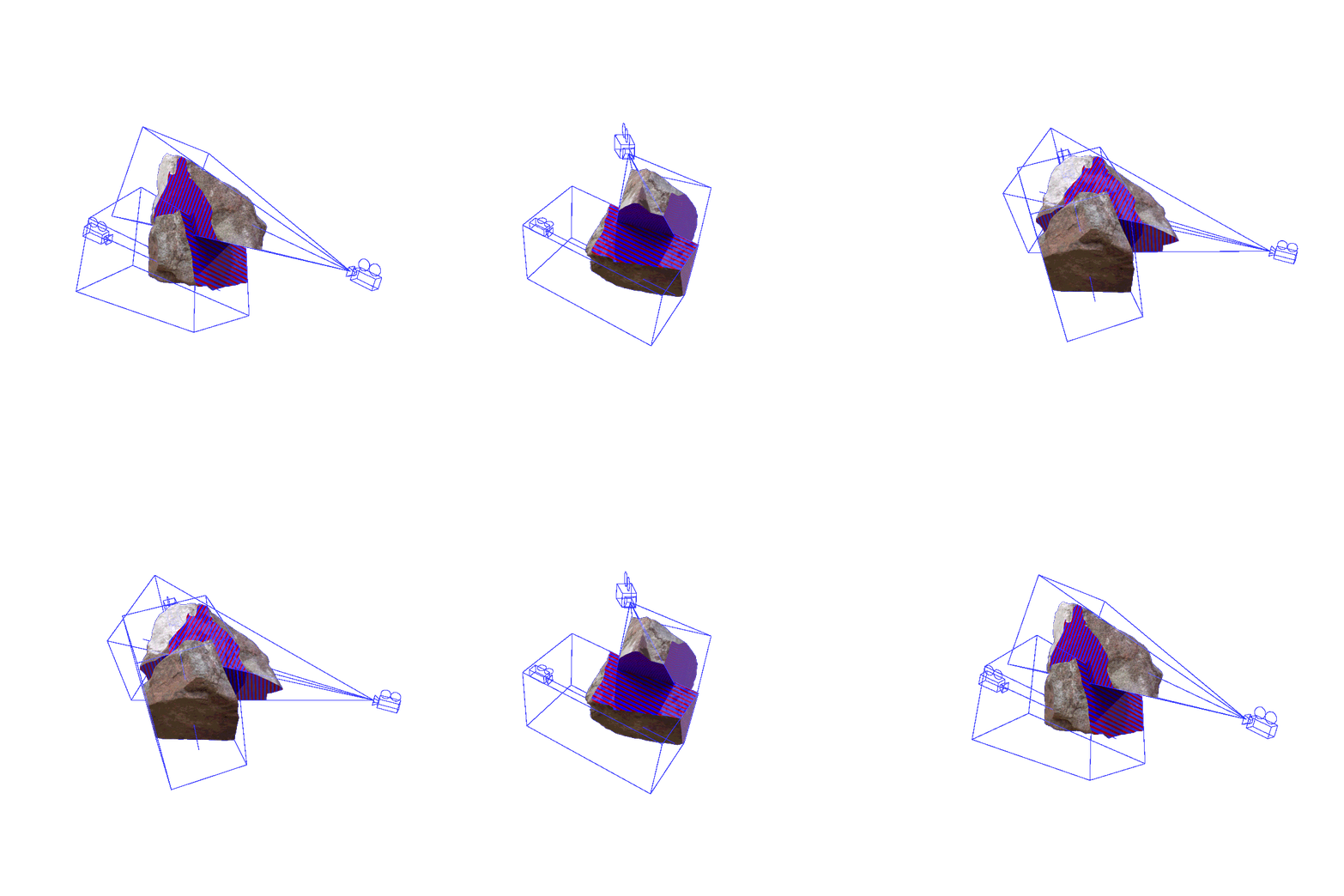
Through high-resolution spatial scanning and a custom-built digital camera interface, the temple is reconstructed piece by piece from the deconstruction site, revealing its layered existence across time. Architectural elements such as stylobates, columns, dougong bracket sets, and roof systems were physically framed by scaffolding structures during demolition. These scaffolding systems, carefully aligned to the temple’s proportions, echoed the logic of the original architecture. Often overlooked and transient by nature, they became a critical architectural index, reflecting traditional proportional systems and the labor embedded in processes of construction, repair, and removal.

Commissioned for the Sino-Ocean Taikoo Li Chengdu, one of the most influential public LED screens in China, the project draws directly from the adjacent local temple site. While the commission was underway, the temple was being dismantled as part of a commercial shopping complex expansion. Seizing this moment of irreversible transformation, the project team conducted piece-by-piece 3D scanning, digitally documenting and curating the architectural components from a historical preservation perspective.
Throughout this process, the project documented an often-overlooked architectural condition. In traditional construction, temporary beams and columns are introduced to support roof structures during assembly and are later removed. These provisional elements, like scaffolding, adhere to the same proportional and structural logic as the permanent architecture. In TimeSlicer, these layers, including scaffolding, architectural envelope, and internal temporary support systems, are revealed through a custom automavision interface. This interface allows a virtual camera to slice through architectural strata and expose the constructional and deconstructional sequence of the temple.
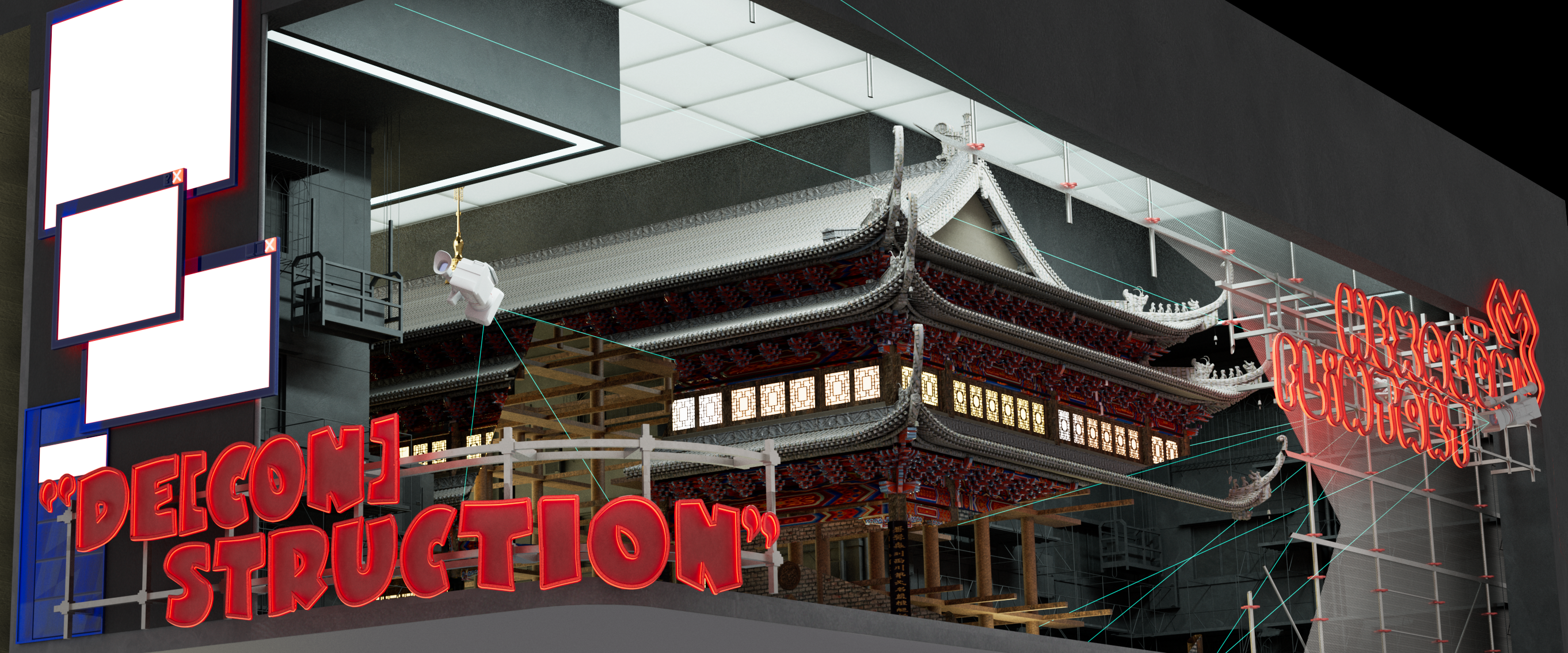
The work functions as a temporal device that slices through time, revealing the birth, support, transformation, and disappearance of architecture. As the temple was fully dismantled, the digital reconstruction began playing on the LED screen, transforming the public display into a site of collective witnessing and memorialization. What no longer exists physically continues to persist as a digital presence, preserving the architectural imprint of the temple within the city’s visual memory.
By staging a confrontation between traditional architecture and contemporary digital media, TimeSlicer reframes heritage not as a static object, but as a living system shaped by labor, temporality, and loss. The project proposes digital art not merely as representation, but as an active mode of documentation and preservation, offering the public an intensified visual experience that invites reflection on the architectural histories embedded in everyday urban space.